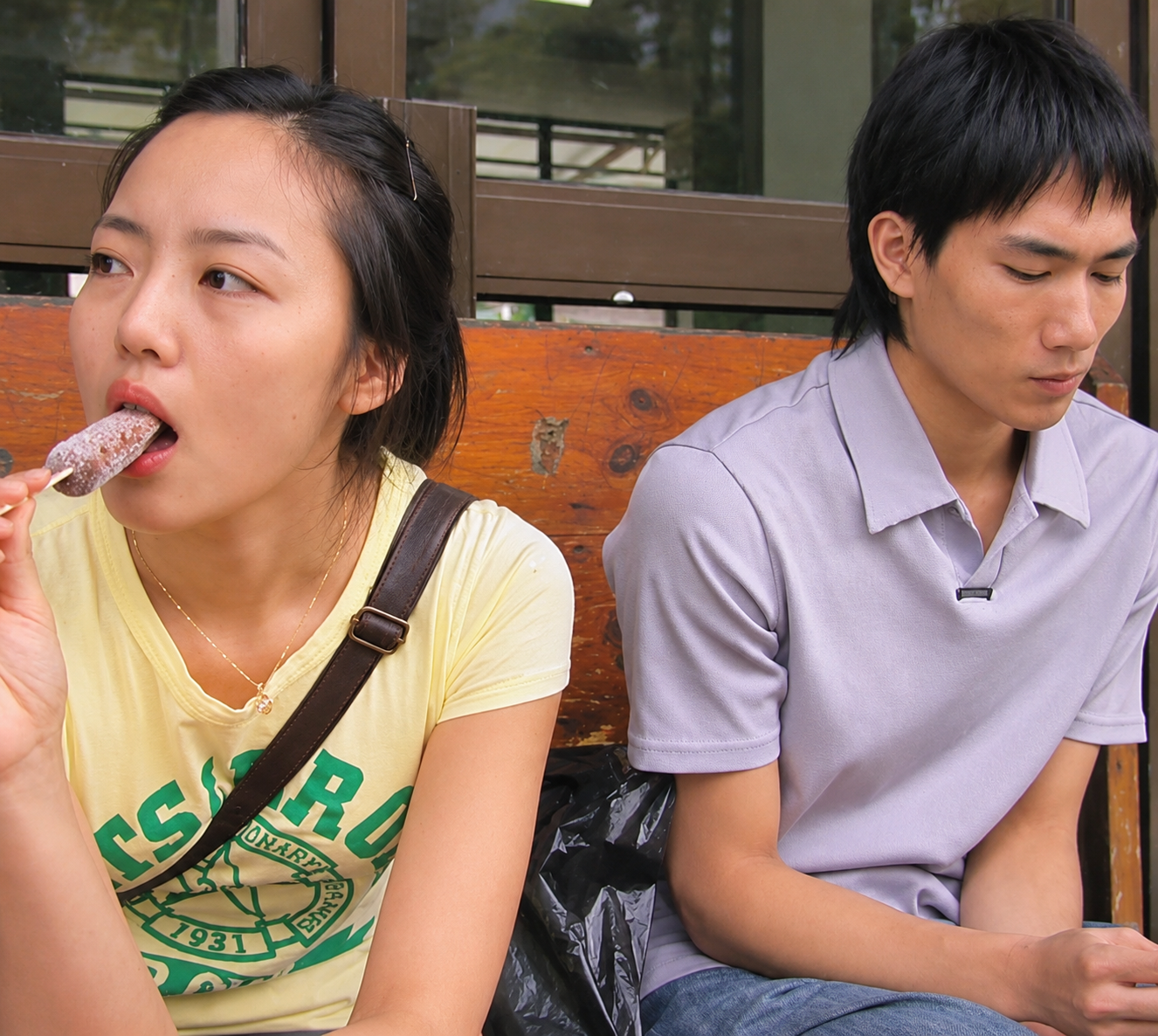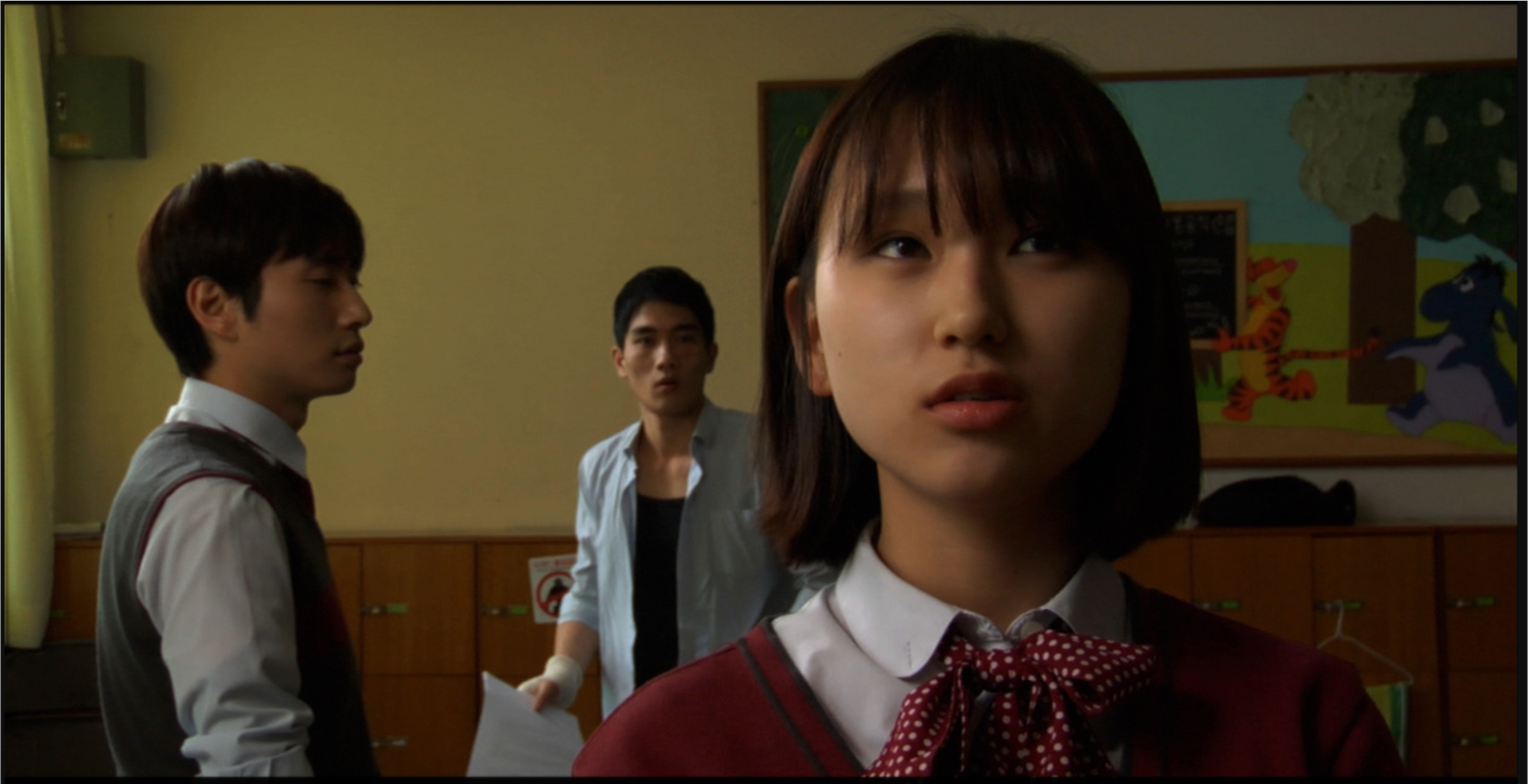
In an early collaboration between Uhm Tae-hwa and Uhm Tae-goo, the comforts of domestic life become the foundation of a darkly comic story about belonging, concealment, and the uneasy boundaries of home.
- Film: Home Sweet Home (유숙자)
- Year: 2010
- Director & Writer: Uhm Tae-hwa (엄태화)
- Cast: Uhm Tae-goo (엄태구), Min Young (민영)
- Genre: Short Film
There is a particular kind of pleasure in watching a film that trusts its audience to pay attention. An object appears briefly in the corner of a frame, a character repeats an inconsequential gesture, or the camera remains still a little longer than expected. Nothing announces itself as important. Its significance becomes apparent only later, when an earlier moment returns in an entirely different context.
Uhm Tae-hwa’s Home Sweet Home (유숙자, 2010) is built around this kind of storytelling. An early short film featuring his younger brother, Uhm Tae-goo, it finds considerable humor and discomfort in activities that rarely receive much attention on screen: eating, washing, getting dressed, watching television, and preparing for bed.
The premise is modest, the setting largely confined to an ordinary apartment building, and the dialogue far less important than the physical behavior of its characters. Yet the film develops an increasingly elaborate sense of suspense through its handling of space, sound, and familiar household objects.
Its humor is occasionally crude, sometimes unexpectedly funny, and not always comfortable. Beneath the absurd situations is a remarkably attentive portrait of people seeking the ordinary comforts of home, though not necessarily under circumstances that allow those comforts to coexist.
The following review contains spoilers.
A Room That Already Has a Personality
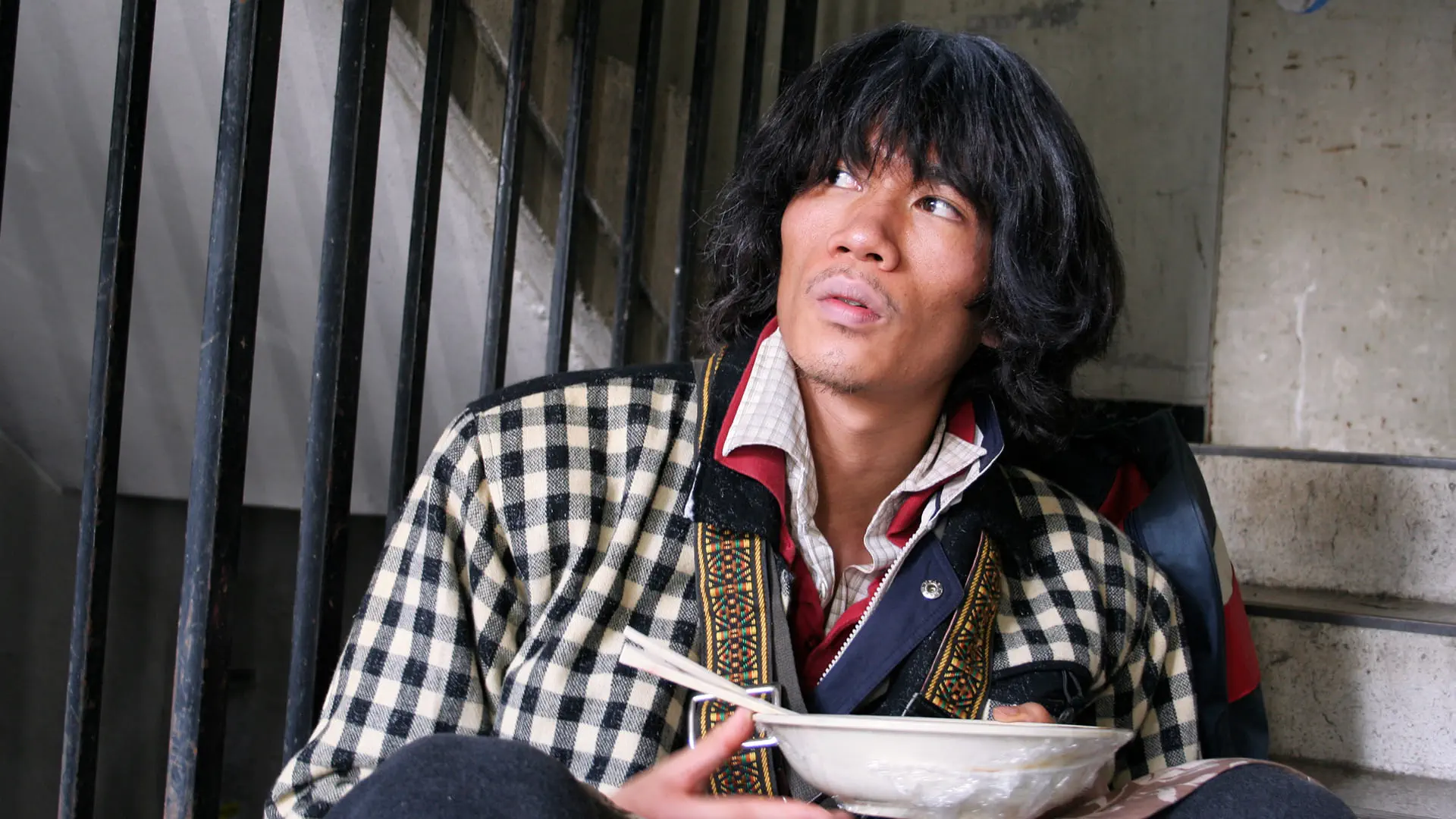
The film opens with a quiet image of a white flowerpot positioned beside a window. A small flower grows among green leaves. A hand enters the frame and sprays water onto the plant before the camera reveals Man-sik (Uhm Tae-goo), a disheveled man with long, tangled hair, wearing a dirty plaid jacket over an unlikely combination of clothes, including a floral dress-like garment and a bright red cardigan.
The contrast is immediately curious. Despite his neglected appearance, the first thing Man-sik is shown doing is tending to a plant.
He then drinks from a small bottle, tilting it high enough to empty the last drops, some of which run down his neck. Once finished, he casually throws it onto the floor.
He is sitting on a bed beside a Hello Kitty plush toy dressed in red, complete with a matching bow. Elsewhere in the room are mirrors, feminine clothing, and a prominently displayed photograph of a woman.
These details establish the apartment’s character before its circumstances are explained. The interior has a distinctly personal appearance, yet Man-sik moves around it without the slightest hesitation.
He collects a large black sports bag and leaves through the weathered sky-blue door of apartment 303. After walking away, he remembers that he has forgotten to lock it and returns.
That small act of responsibility becomes rather amusing in retrospect. Man-sik takes care to secure an apartment that does not appear to belong to him.
Outside, the building’s narrow corridor is lined with cream-colored walls and a succession of similarly colored doors. Against this relatively subdued setting, a door stand out painted in mint green color.
The colors establish a recognizable geography within an otherwise repetitive residential building. The distinction does not necessarily carry a deeper symbolic meaning, but it makes the apartment visually identifiable whenever the film returns to the corridor.
Tae-hwa pays similar attention to the furnishings inside. The Hello Kitty plush toy is not an isolated decoration. A matching character appears on Man-sik’s keychain, while another sticker can be seen on the toilet-seat cover in the bathroom. Pink accessories, including a toothbrush and bathrobe, reinforce the apartment’s recognizable domestic character.
Rather than insisting that the repeated motif represents a particular psychological trait, it is more useful to observe how it establishes continuity. The decorations suggest a consistent personal taste, extending from the bedroom to the bathroom and even to an accessory carried outside the apartment.
They are also among the first indications that the room has a life beyond the man currently occupying it. Man-sik seems entirely at ease among these belongings. He knows where things are kept, moves through the apartment confidently, and follows routines that suggest considerable familiarity.
The film does not immediately challenge that familiarity. It simply allows the audience to become accustomed to seeing him there.
The Daily Rituals of an Unusual Resident
Man-sik’s activities outside the apartment provide a different view of his circumstances. On his way downstairs, he stops at an open window on the staircase landing, looks down, spits, and continues walking.
The gesture appears inconsequential until it is repeated later. Outside, Man-sik collects leftover noodles from two bowls and eats them hungrily while sitting on a staircase. A dog stands nearby, watching him with reddish food stains around its mouth.
Eventually, Man-sik leaves his remaining noodles for the animal. It is a small act of generosity, particularly from someone who appears to have little food of his own.
Before heading out, he unfolds what resembles a mobility cane and puts on dark sunglasses. The combination suggests that he may be presenting himself as visually impaired while begging, although the film leaves the exact circumstances uncertain.
What follows is one of Tae-hwa’s most effective visual transitions. After Man-sik disappears from view, the camera remains fixed on the exterior of the apartment building with with “유숙자” carved on its wall.
For an unusually long stretch, the composition does not change. Gradually, however, the daylight begins to diminish. The building grows darker, and Man-sik eventually returns through the same frame. The transition from morning to evening takes place without a conventional cut or a change in camera position.
It is a simple but carefully timed device. Rather than filling the intervening hours with additional scenes, Tae-hwa allows the changing light to tell the audience that a day has passed. The stationary composition also reinforces the building’s role as the fixed point around which Man-sik’s daily routine revolves.
The approach recalls the attention to light and visual transitions found in Tae-hwa’s earlier short film Forest (2009). In both cases, changes within the image can carry information that might otherwise require an edit or an explanatory scene.
On his return, Man-sik stops at the same staircase window. He looks down and spits again. The repetition gives the gesture an oddly procedural quality, almost like an employee clocking in and out of work. In Man-sik’s case, there is no conventional workplace in sight, but his movements have their own schedule: departure in the morning, return in the evening, and the same unpleasant ritual marking both.
This time, however, he notices the dog scavenging through rubbish below. Holding a bottle of soju, Man-sik briefly gestures toward the animal as though offering it the remaining alcohol. Instead, he extends his arm through the window and drops the bottle.
It shatters on the ground, frightening the dog. The contrast with the earlier feeding scene is difficult to ignore. The same man who willingly shared his food now frightens the dog without any apparent provocation.
Tae-hwa provides no explanation for this reversal, nor does the film attempt to reconcile it with Man-sik’s earlier kindness. His circumstances may invite sympathy, but his behavior remains inconsistent. He is capable of generosity and casual cruelty, of care and disregard.
The contradiction prevents Man-sik from becoming a straightforward portrait of an unfortunate man deserving uncomplicated compassion. There is vulnerability in his circumstances, certainly, but that vulnerability does not guarantee kindness.
The Problem of Leaving Traces
When Man-sik returns to apartment 303, a handwritten notice has been attached to the door. It requests payment of three months’ overdue rent, followed by a bank account number. Man-sik ignores it and enters.
Inside, he drinks directly from a large bottle taken from the refrigerator, pressing his mouth around its opening. The film then moves into an extended sequence of personal hygiene, paying close attention to details that are usually omitted from conventional depictions of domestic life.
Man-sik’s teeth are badly neglected, with visible buildup. He studies them in the mirror before struggling to extract toothpaste from an almost empty tube. He squeezes it with considerable force, carefully depositing the last available portion onto a pink toothbrush.
After brushing, he spits into the sink. Blood mixes with the toothpaste foam. Then he notices several strands of hair in the washbasin. He picks it up and examines it. This apparently minor action offers a possible explanation for the elaborate grooming that follows.
Man-sik positions himself over the toilet and begins cutting his hair with scissors. Rather than allowing the clippings to fall across the bathroom floor, he deliberately directs them into the toilet bowl. He continues with a razor until his head is closely shaved.
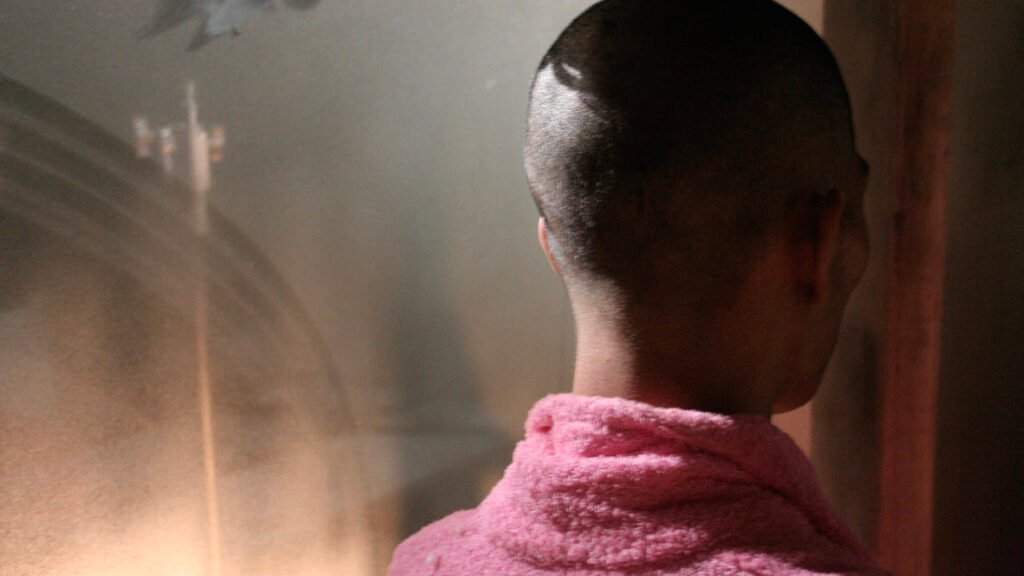
Afterward, he notices another stray hair near the toilet seat, apparently from his pubic area. He subsequently shaves his pubic hair as well. At first glance, the sequence looks like an excessive, somewhat grotesque attempt at cleaning himself. His neglected appearance certainly gives him reason to want a haircut. But the order of his actions suggests another possibility. Man-sik may be trying to eliminate the physical traces that could reveal his presence in the apartment.
Hair falls without warning. It accumulates in sinks, bathrooms, on bedding, and across floors, often without its owner noticing. For someone occupying another person’s home in secret, it represents an inconvenient kind of evidence.
Man-sik’s decision to examine the fallen strands, followed by his careful positioning over the toilet, makes the sequence appear less arbitrary than it first seems. The subsequent removal of his pubic hair strengthens the possibility that he is attempting to control what his body might leave behind.
The film does not explicitly establish concealment as his motive. Personal hygiene and the practical disposal of hair may be equally relevant. Nevertheless, the visual progression gives the interpretation considerable weight.
More importantly, Tae-hwa later introduces a wonderfully ironic consequence. When the woman who lives in the apartment uses her razor, she discovers an unfamiliar hair caught in it. The very instrument Man-sik used while apparently attempting to eliminate evidence has retained a trace of him. His precautions have not quite worked, and the irony extends beyond the bathroom.
Man-sik is careful enough to consider the possibility of shedding hair, yet careless enough to drink directly from someone else’s bottle, nearly exhaust the toothpaste supply, use personal belongings, and leave other signs of his activities throughout the apartment. He seems capable of anticipating one kind of exposure while remaining remarkably oblivious to others. This uneven attention to detail is an important part of the film’s humor. Man-sik is resourceful, but hardly meticulous in every respect.
There is another dimension to the sequence, however, that makes it more than an elaborate joke. For someone without dependable access to a private bathroom, being able to wash, shave, brush his teeth, and change into clean clothing may constitute a genuine comfort.
Man-sik’s physical neglect does not necessarily indicate an absence of concern for his own body. Once he has the facilities available, he spends considerable time attending to it. The grooming can therefore be understood as both an attempt to make himself comfortable and, possibly, an effort to make his presence less detectable. That combination is consistent with much of his behavior. He wants to enjoy the apartment as though it were his own, while ensuring that its actual resident never discovers he has been there.
Making Himself at Home
After completing his grooming routine, Man-sik emerges wearing a pink bathrobe. He stuffs his dirty clothes and other belongings into a large bag, then hides it among stored items. The act of concealing his possessions is another indication that he understands the need to keep his presence hidden.
What follows is almost unexpectedly peaceful. Man-sik retrieves knitting yarn from a kitchen cabinet, settles comfortably on the bed, and begins making what appears to be a scarf while watching television.
Every so often, he holds the unfinished knitting against his neck to check its length. The Hello Kitty plush toy sits beside him facing Man-sif, as if staring at him.
There is something faintly charming about the contrast between this quiet activity and the ungainly grooming sequence that preceded it. Tae-goo plays the moment with a concentration that makes knitting seem like an entirely familiar pastime for Man-sik.
It is worth resisting the temptation to treat the activity itself as inherently comic. There is nothing remarkable about a man enjoying knitting. What makes the image peculiar is the context. Outside, Man-sik scavenges for food, carries his belongings, and appears to lead a physically uncomfortable existence. Inside, he can wash, change clothes, watch television, occupy himself with a hobby, and eventually sleep in a proper bed.
The apartment provides more than just shelter; it also offers him a temporary version of ordinary domestic life. And for a while, Man-sik appears perfectly content. The discomfort lies in the fact that this contentment depends on the absence of the person who actually lives there.
A Shift in Perspective
The sound of approaching high heels abruptly ends Man-sik’s comfortable evening. He has fallen asleep on the bed, embracing the Hello Kitty plush toy. As the footsteps draw closer, his snoring stops and he wakes immediately.
A woman, played by Min Young, enters the apartment, switches on the lights, and begins her evening routine. Her appearance corresponds to the framed portrait introduced earlier, confirming the significance of a detail that had remained unexplained since the opening sequence.
Man-sik disappears beneath the bed. From this point onward, the film changes how the audience experiences the apartment. For much of the first half, Man-sik has been the familiar presence within the space. He moves freely, knows where things are kept, and treats the rooms as somewhere he can relax.
The woman’s arrival reverses that freedom. The same apartment now becomes a confined environment in which Man-sik must restrict his movements, conceal his body, and constantly monitor his surroundings.
The camera begins emphasizing obstructed views, cramped hiding places, and the limited perspective available to someone watching from beneath a bed.
Cardboard boxes partially conceal Man-sik as he observes the woman’s movements. At one point, he pulls a box toward himself to reduce the chance of being seen.
Later, his face appears in the reflection of a small oval mirror on the woman’s dressing table. The use of reflective surfaces creates an additional layer within the composition. The woman occupies the room without knowing that someone else is watching, while Man-sik’s reflection reveals his presence to the audience.
The framing bears a loose visual resemblance to the use of mirrors in Wong Kar-wai’s In the Mood for Love, although the dramatic purpose here is entirely different. Rather than suggesting emotional distance between two visible characters, the reflection exposes an observer who is not supposed to be there.
The woman’s interaction with the Hello Kitty plush toy provides another carefully timed moment. When she speaks toward the room, the camera quickly follows the apparent direction of her attention, briefly creating the possibility that she has discovered Man-sik. Instead, she appears to be addressing the toy.
It is a simple misdirection, but an effective one. The object has already been established repeatedly, so the reveal feels consistent with the apartment’s domestic world rather than an arbitrary joke.
More significantly, the audience has become accustomed to Man-sik’s perspective. His sudden need to hide naturally creates suspense over whether he will be discovered. But that response is psychologically uncomfortable. The woman is not pursuing him; she is simply returning to her own apartment.
The film encourages concern for an intruder’s concealment even as it makes the consequences of that concealment increasingly disturbing.
The Sounds of an Occupied Room
Much of the second half relies on the smallest household noises. The persistent dripping of a tap, the creaking of wooden flooring, the movement of objects, and the sudden crackle of bubble wrap all become potential threats to Man-sik’s hiding place.
The film repeatedly emphasizes the woman’s attempts to locate the source of unfamiliar sounds. At one point, a close shot of her ear draws attention to the act of listening itself. She looks around, apparently aware that something is unusual, but unable to establish exactly where the disturbance originates.
Eventually, she seems to conclude that the noise is coming from the apartment upstairs. She retrieves an empty bottle and uses it to knock against the ceiling, presumably hoping that the upstairs occupant will stop making noise.
The actual source is only a short distance away. The scene is genuinely funny because of the discrepancy between what the woman believes and what the audience knows.
Later, Man-sik attempts to retrieve his knitting yarn but accidentally steps on a piece of bubble wrap. The sudden sound sends him scrambling into a wardrobe concealed by a curtain.
These moments reveal Tae-hwa’s ability to develop suspense from entirely ordinary objects. A dripping faucet or a piece of discarded packaging becomes consequential simply because the characters are operating with different information.
The woman’s behavior adds another layer of uncertainty. Throughout the evening, she speaks on the phone, takes medication, exercises, and occasionally reacts with visible frustration. At one point, she throws her phone and scribbles intensely in a notebook. After another disturbance, she strikes at something near the wardrobe before discovering an insect and laughing.
Her responses are not always consistent. Sometimes she is highly attentive to the smallest sound; at other times, she dismisses disturbances that might reasonably warrant investigation.
These details suggest that she has her own difficulties, but they do not establish a particular psychological condition. Her medication and emotional reactions should not be treated as sufficient grounds for a diagnosis.
The more relevant observation is that her experience of the apartment differs radically from the audience’s. For the viewer, the unexplained noises have a visible source. For the woman, they remain uncertain and potentially attributable to any number of ordinary causes. The suspense grows out of that difference in knowledge.
The Discomfort Behind the Comedy
There is a troubling aspect to the way Home Sweet Home invites its audience to follow Man-sik’s attempts at concealment. His awkward movements and frantic reactions are often entertaining. Every near-discovery creates tension, and every successful escape briefly releases it.
But the humor becomes harder to accept without reservation during the wardrobe sequence. While Man-sik is hiding behind a partially transparent curtain, the woman accidentally loses her towel during a phone conversation.
He watches her naked body and visibly becomes sexually aroused. The curtain moves outward, producing a moment of crude physical comedy.
The scene then takes a more threatening turn. Man-sik begins to emerge from hiding and reaches toward the woman from behind. Before physical contact occurs, her sudden raised voice during the conversation startles him into retreating.
The timing resembles slapstick, but the possibility being interrupted is not harmless. His behavior briefly raises the threat of sexual assault. This is where the film’s shifting perspective becomes especially important.
Man-sik has been presented as physically neglected, economically vulnerable, occasionally generous, and often ridiculous. His attempts to avoid detection can be amusing because the audience understands his immediate predicament.
But the woman’s circumstances are no less important. She has returned to what she believes is a private space, where she can undress, bathe, speak on the telephone, and go about her evening without being observed.
Man-sik’s concealment deprives her of that privacy. His need for shelter can be recognized without excusing the violation he commits. Likewise, acknowledging the woman’s vulnerability does not require reducing her to a passive figure whose only purpose is to threaten his discovery.
Tae-hwa keeps the humor and discomfort close together, sometimes allowing one to emerge from the other. The resulting tension is not simply about whether Man-sik will get caught. It also concerns the audience’s willingness to become invested in his success despite understanding what that success means for the person who lives there.
The Things They Share Without Knowing
As the woman’s evening continues, the apartment begins to reveal just how thoroughly Man-sik has occupied it. The water bottle he drank from reappears in her hands. She struggles with the toothpaste tube he nearly emptied. She discovers the unfamiliar hair caught in her razor. Later, she wears the same pink bathrobe.
These repetitions form an understated chain of cause and effect. Each object has an ordinary purpose, yet its reappearance carries information that the woman does not possess. The apartment is full of evidence, but none of it announces itself clearly enough to reveal the intruder.
The knitting yarn provides one of the film’s more amusing examples. Earlier, Man-sik retrieved a roll of yarn and spent part of his evening carefully working on a scarf. Later, the woman notices a loose strand and begins pulling it, unknowingly unraveling the knitting. The action is simple, but its humor depends entirely on remembering the earlier scene. The ownership of the yarn remains uncertain. Because Man-sik retrieves it from a kitchen cabinet, it may already belong to the woman. That possibility would also explain why she does not seem particularly surprised by its presence.
Regardless, the yarn becomes part of both characters’ routines. The woman later uses it for a finger-string game while relaxing on the bed.
The same pattern is visible in their interactions with the Hello Kitty plush toy. Man-sik sits beside it, eventually embraces it, and falls asleep holding it. The woman later does much the same.
The repetition is not necessarily intended to imply that the two characters share a personality. Rather, it demonstrates how the same objects accommodate separate domestic routines. Even their untidiness provides a small parallel.
Man-sik casually discards an empty bottle earlier in the film. When the woman returns, she removes the overdue-rent notice from the door, crumples it, and throws it toward the rubbish bin, missing the target. Neither is presented as a particularly orderly resident. These similarities do not erase the difference between them. One appears to live in the apartment legitimately, while the other occupies it secretly.
But they complicate the idea that the space belongs to two entirely different kinds of people. Both are capable of ordinary carelessness. Both seek comfort in familiar objects. Both have private habits that they perform without considering how those activities might look to an observer. The difference is that Man-sik has become precisely such an observer.
What Makes a Home Sweet?
The title Home Sweet Home acquires its irony gradually. For Man-sik, the apartment offers the material comforts that make a home desirable: running water, a bathroom, clothes to change into, a television, a bed, and the freedom to spend time doing nothing particularly important. His enjoyment of these things is recognizable. There is nothing extravagant about wanting to eat, wash, knit, watch television, and sleep somewhere comfortable.
Outside, his circumstances appear harsh. Inside, he briefly experiences the routines of a more settled existence. The apartment allows him to feel at home. But that feeling depends on remaining unnoticed.
For the woman, home carries a different expectation. It is a place where she can return after her day, remove her makeup, take medication, make phone calls, bathe, and rest without having to account for another person’s presence. Her sense of comfort depends not on hiding, but on the assumption that she has privacy.
Man-sik’s intrusion undermines that assumption, even though she remains unaware of it. The overdue-rent notice adds a further complication. The woman’s relationship to the apartment may itself be financially precarious. Having somewhere to live does not necessarily mean being free of insecurity, and the three months of unpaid rent suggest that maintaining the home may be a struggle.
The film does not provide enough information to establish the full extent of her difficulties. Still, the notice prevents the apartment from functioning as an uncomplicated symbol of stability.
Man-sik appears to lack a dependable home. The woman has one, but may be having difficulty keeping it. Their situations are not equivalent, and the film offers no justification for Man-sik’s unauthorized presence.
Yet both characters’ circumstances complicate the easy sentiment behind the familiar phrase home sweet home. A home is not simply a physical space containing furniture and personal belongings. Its comforts also depend on expectations: the ability to return, to rest, to use familiar things, and to be alone when one chooses.
Man-sik experiences many of the practical comforts of the apartment without having an established right to occupy it. The woman has that apparent right, but unknowingly loses the privacy that should accompany it. The same room provides comfort to one person by compromising the other’s sense of safety.
Sleeping Above and Below
The final sequence returns to several images established earlier. The woman settles into bed wearing the pink bathrobe, embraces the Hello Kitty plush toy, and watches a comedy program on television. The knitting yarn is nearby, and she has been using it for her own amusement.
Her routine closely resembles Man-sik’s earlier evening. Both have worn the same robe, occupied the same bed, handled the yarn, and held the plush toy. The repetition gives the closing moments an unusual familiarity. The same collection of objects has served two separate lives over the course of a single day.
Eventually, the woman falls asleep. Man-sik, exhausted from remaining hidden, also falls asleep beneath the bed, among the cardboard boxes. He begins to snore. The sound appears to wake the woman briefly. She opens her eyes, then closes them again. Considering her earlier sensitivity to unexplained noises, the reaction is curious. Perhaps she dismisses it, mistakes its source, or is simply too tired to investigate.
The film offers no definite explanation. Instead of delivering the confrontation it has spent much of its running time threatening, Tae-hwa lets the moment pass. The camera gradually pulls back, revealing the woman asleep on the bed and Man-sik asleep beneath it. The composition is almost absurdly simple. Two people occupy the same small room, separated vertically by a bed and, more significantly, by what they know about each other’s presence.
The woman appears to believe that she is sleeping alone. Man-sik knows otherwise. The image also brings the film back to its most basic human activity: finding somewhere to rest.
After all the elaborate attempts at concealment, the bodily discomfort, the interruptions, and the near-discoveries, Man-sik has managed to secure another night of sleep.
The woman, too, has completed her evening and fallen asleep in her own bed. But their apparent coexistence should not be mistaken for peaceful companionship. There has been no agreement, no acknowledgment, and no mutual understanding.
The woman remains unaware that her private life has been observed. Man-sik remains concealed, having successfully avoided the consequences of his intrusion. Tae-hwa does not resolve their circumstances or reveal what might happen the following morning. He leaves the situation exactly where its contradictions are most visible: two exhausted people sleeping within the same frame, one above the other, in a home that means something very different to each of them.
The Precision Beneath the Absurdity
What gives Home Sweet Home its distinctive character is the relationship between Uhm Tae-hwa’s carefully arranged visual details and Uhm Tae-goo’s intensely physical performance.
Tae-hwa establishes the apartment through recurring colors, decorations, and objects before their significance becomes apparent. The Hello Kitty accessories give the interior continuity. The contrasting doors make the building recognizable. The repeated staircase gesture establishes Man-sik’s daily rhythm, while the stationary exterior shot uses changing daylight to mark time.
Inside, everyday objects become instruments of comedy and suspense. A nearly empty toothpaste tube, an unfamiliar hair, a roll of knitting yarn, and a piece of bubble wrap matter not because they possess elaborate symbolic meanings, but because their presence and consequences have been established with care.
The film’s visual construction is equally attentive to perspective. Man-sik initially moves through the apartment with complete freedom. After the woman’s arrival, the same rooms become restrictive, filled with potential hiding places, obstructed views, and sounds that might reveal him.
The setting has not changed, but the relationship between the characters and the space has. Uhm Tae-goo gives that transformation its physical dimension. His performance depends not on dialogue but on the peculiar details of Man-sik’s behavior: the hurried eating, the awkward grooming, the careful extraction of toothpaste, the concentration in his knitting, and the increasingly desperate attempts to remain hidden. Man-sik has no dialogue throughout the film, only a moment of humming while in the bathroom.
There is little concern with making the character conventionally appealing. Man-sik can look pitiful in one scene, oddly endearing in another, and genuinely disturbing shortly afterward. His circumstances are difficult, but he is neither consistently sympathetic nor beyond criticism. The performance is effective precisely because it permits those contradictions to remain.
Tae-hwa, meanwhile, finds an unusual balance between the ridiculous and the unsettling. The film’s humor is often rooted in recognizable domestic inconveniences, but those inconveniences gradually reveal the consequences of occupying another person’s private space.
Man-sik’s attempts to eliminate his hair offer a particularly fitting expression of that contradiction. He appears concerned that his body might leave traces, yet he has already made himself part of the apartment’s daily life. He uses its possessions, consumes its supplies, disturbs its furnishings, and leaves behind small changes that the resident encounters without understanding their origin.
His body may be hidden, but his presence is everywhere. By the end, the film has established two competing experiences of home without granting either character a simple resolution.
Man-sik has found somewhere he can feel comfortable, provided he remains invisible. The woman has a place to which she can return, provided she does not realize that someone has been watching.
Home Sweet Home finds its dark humor in that contradiction. It recognizes the ordinary human desire for shelter and comfort while refusing to overlook the boundaries crossed in obtaining them.
The film’s final image offers no dramatic punishment or comforting resolution. It leaves two people asleep, each having found a measure of rest in the same room, though only one understands the arrangement.
For Man-sik, home is somewhere he can live without being seen. For the woman, it is somewhere she should be able to live without being watched.
Neither experience can be fully reconciled with the other.