There is a certain charm to discovering a filmmaker’s early work, particularly when it offers a glimpse of ideas, instincts, and creative choices that might otherwise go unnoticed in their later productions. Short films made during film school can be especially revealing. Working with limited resources, a small cast, and a brief running time, filmmakers are often left to experiment with the simplest elements of cinema: gestures, framing, rhythm, and the relationship between what is shown and what remains unsaid.
Heart Vibrator (하트바이브레이터, 2011) is one such curiosity. Directed by Um Tae-hwa, the approximately twelve-minute short brings together Um Tae-goo, Hong Seok-jae, and Ryu Hye-young in a modest production that makes surprisingly expressive use of its confined setting.
What makes it worth examining is not the complexity of its premise, but the filmmaker’s attention to seemingly insignificant details. A passing glance, a pause in conversation, an ordinary object, or a change in camera perspective can carry more information than the dialogue itself. There is also an unmistakable sense of mischief in the way certain moments are staged, as though the director is quietly inviting the audience to notice something his characters have yet to recognize.
A Boy by the Window

The film opens with Seok-jae (Hong Seok-jae) standing beside a classroom window. A light breeze moves the curtains around him, creating a surprisingly delicate image. There is something reminiscent of the romantic visual language of Japanese cinema here, particularly the familiar image of a young Takashi Kashiwabara framed by a softly moving curtain. One might even be reminded of the window imagery associated with Shunji Iwai’s Love Letter (1995). Whether the resemblance is intentional is impossible to establish, but the association is interesting given what follows.
The opening presents Seok-jae through an almost romantic composition before gradually revealing how strange his understanding of romance can become. Tae-goo (Um Tae-goo) enters the classroom looking considerably less romantic. His face is bruised, a bandage covers part of his left cheek, and another is visible on his elbow. Wearing a black sleeveless top and tight white ballet leggings, he looks like someone caught between a street fight and a dance rehearsal.
He notices Seok-jae cleaning the classroom and questions why he is doing it. Their conversation suggests that an unpleasant incident has occurred before the story begins. Seok-jae appears apologetic, while Tae-goo remains visibly irritated. The exact circumstances are not fully established through the visual information alone, but the injuries and Seok-jae’s behavior indicate an unresolved tension between them.
Seok-jae has brought a tube of ointment. He takes it out of his pocket, hesitates, and puts it away. He repeats the gesture, seemingly unable to decide whether to offer it. This small prop establishes something important about his character. Seok-jae is capable of preparing a gesture of concern, but not necessarily of carrying it out. His intentions remain trapped between thought and action.
When the school bell rings and Tae-goo begins putting on his clothes, Seok-jae finally announces that he wants to learn ballet. Tae-goo asks why the sudden interest. Seok-jae explains that there are plenty of girls in ballet. It is an almost suspiciously convenient answer.

Ballet as an Excuse for Physical Closeness
Tae-goo responds by putting Seok-jae through a practical demonstration. He approaches him with an intimidating confidence, pulls him into position, and stretches their legs across the classroom floor. Seok-jae cries out in pain while Tae-goo instructs him to regulate his breathing. The scene is funny partly because of the contrast between Tae-goo’s appearance and his discipline. His bruised face and rough manner suggest someone more accustomed to fighting than dancing, yet his movements are controlled and assured.
The outfit adds another contradiction. The fitted white leggings expose the contours of his body, making his physical presence impossible to ignore. Seok-jae certainly notices. During the stretching exercise, his gaze drifts downward toward Tae-goo’s leggings. The camera allows the audience to register where he is looking before the lesson continues.
Tae-goo then adjusts his posture, instructing him to lift his gaze approximately fifteen degrees and correcting the positioning of his arms and body. At one point, he even compliments Seok-jae’s physique as suitable for ballet. The contact is ordinary within the context of dance instruction. An instructor must physically demonstrate positions and correct a student’s alignment.
For Seok-jae, however, that professional context seems to provide a convenient opportunity for closeness. This is where ballet becomes particularly useful to the film’s storytelling. It is an art form that depends on physical discipline, posture, touch, and bodily awareness. The same movements can therefore carry two entirely different meanings depending on who experiences them.
Tae-goo is teaching, and Seok-jae appears to be experiencing something considerably more personal. His stiff expressions, nervous swallowing, and difficulty maintaining composure reveal a growing disparity between what he says and what he feels. The film does not need him to confess anything. His body has already begun betraying him.
The Girl in the Red Cardigan

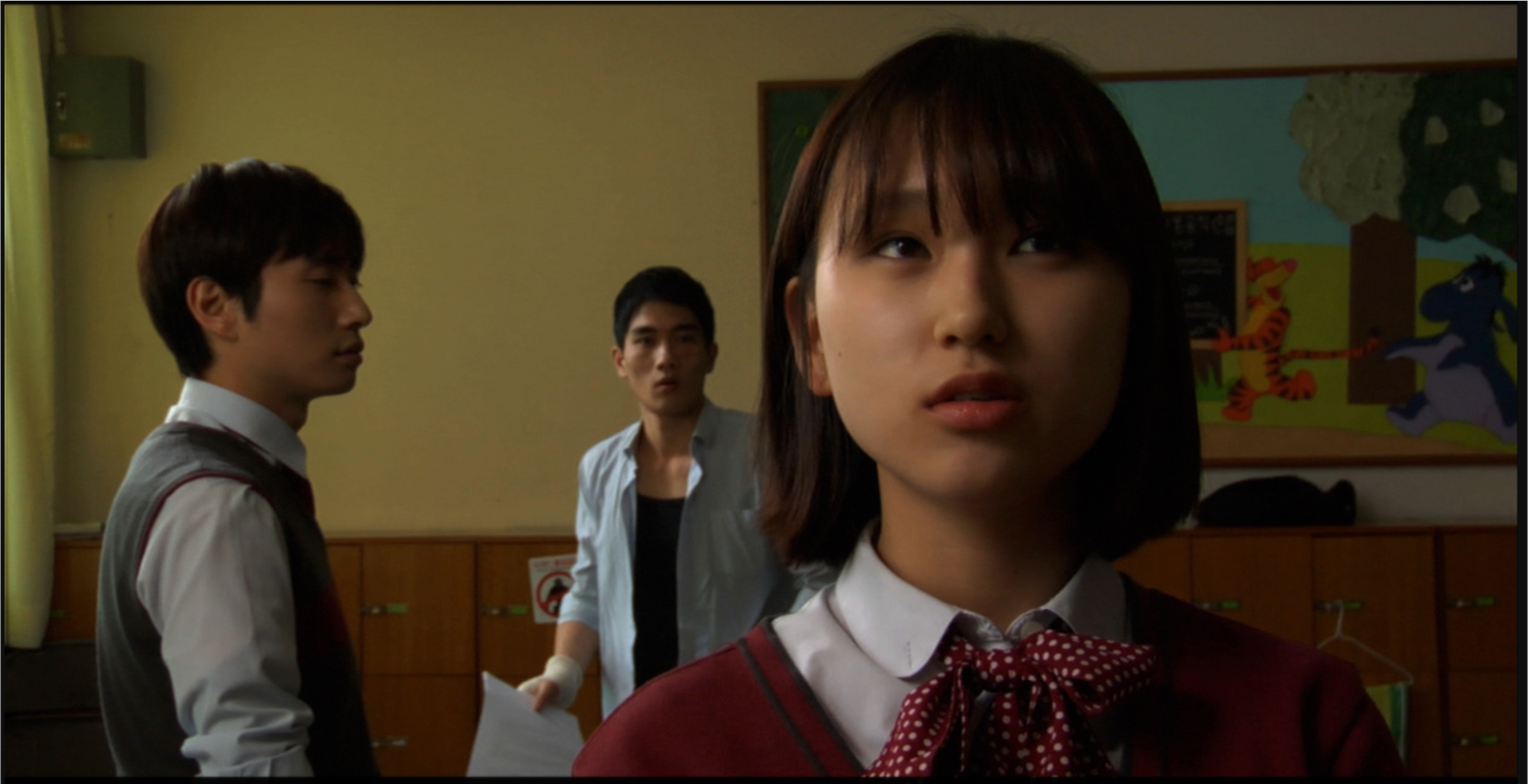
Ji-hye (Ryu Hye-young) enters the classroom wearing a school uniform, a red cardigan, and earphones connected by a visible wire. Her short bob haircut and bright yellow bag give her an immediately recognizable presence. The colors matter visually.
Against the relatively subdued classroom and Tae-goo’s monochromatic ballet clothing, Ji-hye’s red cardigan and yellow bag introduce a livelier palette. Her entrance brings a change in energy, but also disrupts the intimacy Seok-jae has been quietly constructing.
She presents an application to join the ballet club, and of course Tae-goo welcomes her. Seok-jae does not seem nearly as pleased as it shown when the camera repeatedly observes his reactions as he watches the two interact. His gaze moves between Tae-goo and Ji-hye, and his expression becomes increasingly hostile.
Ji-hye talks cheerfully, apparently unaware of the resentment developing across the room. She brings up a rumor circulating among their classmates, prompting Tae-goo to laugh. Seok-jae responds with an uncomfortable smile, seemingly unwilling to participate in their amusement. The contrast between their reactions establishes the emotional arrangement of the scene without requiring an explicit confrontation.
Ji-hye is interested in Tae-goo, or at least comfortable approaching him. Tae-goo appears interested in her attention. Seok-jae, meanwhile, resents the possibility of losing the attention he has worked so awkwardly to obtain.
When Tae-goo begins teaching Ji-hye, the film places Seok-jae in the position of an observer. This shift is significant. Earlier, Seok-jae occupied the space immediately beside Tae-goo, receiving his instructions and physical corrections. Now he watches someone else take his place. Tae-goo eventually calls him over to demonstrate a position for Ji-hye.
While Tae-goo continues explaining the movement, Seok-jae directs a severe stare at her. Ji-hye notices. Her previously cheerful expression changes, and she becomes visibly uncomfortable. Shortly afterward, she excuses herself and prepares to leave.
Before departing, she makes a remark acknowledging Tae-goo’s fighting ability. Tae-goo reacts with obvious satisfaction, apparently flattered by the recognition of his toughness. It is a wonderfully absurd detail. The same man who has been carefully demonstrating ballet positions seems delighted to have his masculinity acknowledged through a fight.
When Tae-goo returns after seeing Ji-hye out, Seok-jae is still holding the ballet position he was instructed to perform. Perhaps he expects to be praised for his obedience. Instead, Tae-goo looks confused. Seok-jae has once again mistaken excessive attentiveness for an effective way of winning affection.
The Things People Say Instead of What They Mean
One of the film’s recurring verbal details is Seok-jae’s repeated reassurance that everything is all right. The phrase becomes increasingly peculiar as the story progresses. Seok-jae says it when he is uncomfortable, when he declines something, and when his behavior suggests that things are not remotely all right.
Ji-hye appears to echo the expression at one point, and Tae-goo later repeats it as well. The repetition turns an ordinary phrase into a recognizable behavioral pattern. Seok-jae’s words function less as an honest description of his feelings than as a defensive response. He repeatedly insists on normality while behaving in ways that reveal his discomfort. This verbal contradiction is central to the film’s humor.
He cannot openly express what he wants, so he relies on socially acceptable explanations and reassurances. He wants to join ballet because of girls. He is perfectly fine. Nothing unusual is happening, but his face and actions suggest otherwise.
The phrase also works as a small ironic refrain. Each repetition draws attention to the distance between Seok-jae’s outward performance and his private emotional state.
A Sausage, a Conversation, and an Unfortunate Accident
After Ji-hye leaves, Tae-goo and Seok-jae sit together in the classroom, Tae-goo eats a sausage and offers to Seok-jae, who declines.
Then, their conversation turns to Ji-hye. Tae-goo asks whether Seok-jae was in the same class as her the previous year and begins asking what she is like. He admits that he finds her attractive, explaining that he prefers someone with a more approachable, human quality rather than conventional beauty.
He also makes a remark about her breasts. Seok-jae abruptly interrupts, calling Ji-hye a slut. The insult is startling in its hostility. There is little in Ji-hye’s behavior to justify it, and the timing makes Seok-jae’s jealousy difficult to overlook.
Tae-goo reacts so suddenly that he coughs, accidentally spraying chewed sausage onto the back of Seok-jae’s hand. It should be an embarrassing but otherwise insignificant accident. Instead, the film turns it into one of its most revealing moments. Seok-jae does not wipe his hand. He quietly moves it behind his body, concealing the food particles while Tae-goo continues talking.
Seok-jae then volunteers to fetch some drinking water. Outside the classroom, Seok-jae raises his hand toward his mouth and carefully eats the remains of the sausage. The action is deliberate, and it also looks profoundly unpleasant, uncomfortable, and downright disgusting.
The Body as an Object of Desire
The sausage sequence introduces a more disturbing dimension to Seok-jae’s attraction. Until this point, his behavior has largely involved familiar signs of an awkward crush: nervousness, jealousy, prolonged attention, and attempts to remain physically close.
Here, attraction takes the form of an unusual relationship with bodily residue. Something that has been inside Tae-goo’s mouth becomes valuable to Seok-jae precisely because of that physical association. The food itself is ordinary. Its significance changes through contact.
Seok-jae cannot openly obtain the affection he wants, so he attaches meaning to something that has passed through Tae-goo’s body. The result is grotesque. The film’s discomfort comes from recognizing the emotional logic behind an action that remains objectively repulsive.
The Glass of Water: A Romance That Exists Only in His Head
At the water dispenser, Seok-jae fills a transparent glass. He raises it to his mouth, drinks some water, and then allows water from his mouth to return to the glass. The camera pays particular attention to the movement of his mouth and the glass, making it clear that this is not an accidental gesture.
He then carries the water back to Tae-goo. At this point, gentle piano music begins. The contrast is almost outrageous. Having shown Seok-jae deliberately contaminate someone’s drinking water, the film suddenly adopts the visual and musical conventions of a tender romantic exchange.
His return to the classroom is accompanied by soft music and prolonged movements. Tae-goo, meanwhile, is occupied with a headstand, his legs moving playfully above him like clapping. When Seok-jae offers the glass, the moment is presented with an exaggerated sense of importance.
The camera briefly uses the shadows cast by the two figures in the afternoon sunlight. Tae-goo’s drinking is emphasized through the sound of swallowing, while Seok-jae watches with an expression that suggests extraordinary emotional investment. The sequence is so earnestly romantic in its presentation that it becomes even more disturbing.
Romantic Framing and Grotesque Reality
This is arguably the film’s sharpest example of visual irony. The music, sunlight, slow motion, and shadow composition belong to the familiar vocabulary of screen romance. They are conventions often used to transform a small gesture into a moment of emotional significance. But the audience knows something Tae-goo does not. The water has already been in Seok-jae’s mouth.
The sentimental presentation therefore produces two conflicting readings of the same event. From Seok-jae’s imagined perspective, sharing the water may resemble an indirect contact, an intimate exchange that allows him to experience a connection he cannot obtain openly.
From the audience’s perspective, it is a serious breach of bodily autonomy and consent. The film’s comedy depends on maintaining that contradiction rather than resolving it.
There is also an interesting distinction between the two acts involving bodily residue. First, Seok-jae consumes something that has come from Tae-goo’s mouth. Then he arranges for Tae-goo to consume something that has been in his own. The direction of the exchange is reversed. The two actions form an imagined circuit of intimacy, with food and water functioning as substitutes for the physical contact Seok-jae desires. Scary.
Whether every aspect of this symmetry was consciously intended by Um Tae-hwa cannot be established. Nevertheless, the sequence is constructed clearly enough to support such a reading. The use of shadows is especially suggestive. For a moment, the characters’ bodies are represented through their silhouettes rather than through direct physical contact.
Their apparent closeness becomes an image, while the actual relationship remains fundamentally unequal. Seok-jae experiences the exchange as meaningful, but Tae-goo simply drinks a glass of water.
The Broken Window and the Return of Reality
The atmosphere is interrupted by a sudden crash. An object strikes the classroom window, breaking the glass. Seok-jae handles the object and injures his hand. When he looks outside, Ji-hye is standing below, asking for her shoe to be returned.
Her reappearance immediately redirects Tae-goo’s attention. The broken window has an interesting narrative function. Earlier, the window framed Seok-jae in a quiet, almost romantic composition. It separated the enclosed classroom from the world outside. Now that boundary is violently interrupted.
The classroom has served as the setting for Seok-jae’s attempts to create a private relationship with Tae-goo. Ji-hye’s shoe breaks through that space, literally bringing the outside world into his carefully maintained fantasy. This does not mean the broken glass must be understood as a deliberately coded symbol. Its immediate function is to interrupt the scene and bring Ji-hye back into the story. But the visual connection between the opening window and its later destruction is worth noticing.
Tae-goo looks outside and seems delighted to see Ji-hye. Seok-jae, meanwhile, is left holding his injured hand. Tae-goo quickly prepares to leave, telling him they can continue their ballet practice tomorrow. Seok-jae suddenly grabs his shirt. The gesture is brief but unusually direct.
Throughout the film, Seok-jae has relied on excuses, indirect gestures, and physical proximity disguised as something else. This time, he openly attempts to stop Tae-goo from leaving. Tae-goo looks at him, apparently irritated or confused, and repeats that they can continue the following day. Seok-jae eventually lets go. The movement is prolonged through slow motion, emphasizing his reluctance to release Tae-goo.
There is something almost painfully adolescent about the gesture. Seok-jae has spent the entire afternoon trying to manufacture reasons for closeness, only to find himself unable to prevent the person he likes from walking away.
The Ointment Returns
Alone in the classroom, Seok-jae finally takes out the ointment. The same tube he had repeatedly considered giving to Tae-goo at the beginning of the film is now used to treat his own injured hand. This is one of the short film’s neatest pieces of visual storytelling. The ointment appears at both ends of the narrative, but its purpose changes. Initially, it represents an attempted gesture of concern toward Tae-goo, possibly connected to Seok-jae’s guilt over their earlier encounter.
By the end, it becomes an object of self-care. Seok-jae never manages to give Tae-goo what he brought for him. Instead, he ends up needing it himself. The irony is understated but effective. His efforts to approach Tae-goo have resulted not in the intimacy he wanted, but in another injury.
The object also completes a small narrative circle. The film begins with Tae-goo’s visible wounds and Seok-jae’s inability to address them. It ends with Seok-jae tending to his own wound after Tae-goo has left. There is no confession or romantic breakthrough, but only a tube of ointment, finally put to use.
One Last Look Through the Window
Seok-jae returns to the window. Outside, Tae-goo and Ji-hye are walking together, chatting and laughing as they disappear behind the trees. The framing recalls the opening scene, but the emotional circumstances have changed.
At the beginning, Seok-jae stood beside the window waiting for Tae-goo to arrive. Now he stands there watching Tae-goo leave with someone else. The window becomes a recurring boundary between Seok-jae and the relationship he wants but cannot reach.
The final sequence introduces one last surprise. After watching the two disappear, Seok-jae turns away from the window and begins performing ballet movements. He stretches, adjusts his posture, and moves with a confidence that was not apparent during his earlier lesson. Then he leaps.
The film ends.
Was He Ever There to Learn Ballet?
The final movement changes how the earlier scenes can be understood. Seok-jae’s sudden competence raises the possibility that his initial request for ballet lessons was never entirely genuine. Perhaps he already knew more about ballet than he admitted. Perhaps his apparent inexperience was exaggerated to create opportunities for Tae-goo to get close to him, correct his posture, and spend time with him. The ending does not establish exactly how much ballet he knew beforehand, but it deliberately invites the audience to question his original explanation. It also returns attention to the difference between performed behavior and genuine feeling.
Throughout the film, Seok-jae performs the role of a novice student. He performs indifference toward Ji-hye. He performs casualness around Tae-goo. He repeatedly insists that everything is all right. His final dance is the one moment when he appears to move without needing another person to guide him.
Whether the leap expresses frustration, longing, release, or some combination of these emotions remains open to interpretation. What is certain is that the film gives his body the final word.
Reading the Film Through Its Objects and Images
For such a short production, Heart Vibrator makes unusually economical use of its setting and props. The window appears at the beginning, is broken near the end, and returns as the place from which Seok-jae watches Tae-goo walk away. It provides a visual thread connecting anticipation, interruption, and disappointment.
The ointment creates a narrative reversal. Prepared for Tae-goo, it ultimately treats Seok-jae’s own injury, transforming an intended gesture of affection into a reminder of his failed attempt at closeness.
The ballet clothing and exercises place the body at the center of the story. Tight leggings, stretching, posture correction, and physical guidance create situations in which ordinary instructional contact becomes emotionally charged.
Ji-hye’s red cardigan and yellow bag distinguish her visually from the classroom’s more restrained palette. Her arrival changes the composition of the relationship as well as the energy of the scene.
The sausage and drinking water introduce a more unsettling symbolic register. Both become carriers of bodily contact, allowing Seok-jae to imagine a form of intimacy without mutual participation.
The piano music and slow motion provide perhaps the clearest example of the film’s mischievous visual language. Romantic cinematic conventions are applied to behavior that is neither romantic nor consensual from Tae-goo’s perspective.
And finally, the closing ballet movement returns to the activity that brought the characters together, revealing that the meaning of the lesson may have been different from what Seok-jae claimed all along.
These details do not need to be treated as a collection of hidden messages waiting to be decoded. Their strength lies in how they interact with the narrative. A prop introduced casually becomes meaningful through repetition. A camera angle changes the emotional interpretation of an ordinary action. Music invites a romantic response to something that should inspire discomfort. The film is playful with these contradictions, sometimes to an almost wicked degree.
Um Tae-goo’s Performance and Um Tae-hwa’s Sense of Humor
For viewers familiar with Um Tae-goo’s later screen work, Heart Vibrator offers an entertaining glimpse of a different side of his acting. His character is physically confident, occasionally aggressive, and unexpectedly playful. The bruised face and rough demeanor contrast with his ability to demonstrate ballet movements, while his reactions to Ji-hye reveal a somewhat vain and easily flattered young man.
He is also remarkably oblivious. Much of the comedy depends on Tae-goo failing to recognize the emotional significance Seok-jae attaches to their interactions. He treats their encounters as practical, ordinary, or mildly irritating, while Seok-jae experiences them as moments of enormous personal importance.
Hong Seok-jae carries the film’s more uncomfortable humor through his facial expressions and physical hesitation. His character frequently says very little, but his glances, swallowing, delayed reactions, and stiff movements expose the feelings he is trying to suppress.
Ryu Hye-young, meanwhile, brings an apparently uncomplicated cheerfulness to Ji-hye. Her presence is essential because it exposes Seok-jae’s jealousy and provides a contrast to his increasingly obsessive behavior.
The three performances work precisely because their characters are not experiencing the same situation in the same way. Um Tae-hwa’s direction takes advantage of that imbalance.
Rather than explaining the love triangle through dialogue, he repeatedly places the audience in a position of knowing more than at least one of the characters. We recognize Seok-jae’s attraction before Tae-goo does. We understand why Ji-hye’s arrival bothers him. Most importantly, we know what happened to the drinking water while Tae-goo remains blissfully unaware.
The humor is therefore built on dramatic irony, visual exaggeration, and the uncomfortable pleasure of anticipating consequences that may never arrive. There is also a particular mischievousness to the editing. The slow-motion treatment of Seok-jae’s gestures, the sentimental piano score, and the attention given to moments of bodily awkwardness suggest a filmmaker who enjoys manipulating the audience’s expectations.
The water sequence is a perfect example. It is difficult not to imagine the filmmakers finding the entire construction rather funny: a romantic musical cue, beautiful afternoon light, and a glass of water that nobody should be drinking.
A Heart That Cannot Speak for Itself
Heart Vibrator is a small film about an enormous emotional inconvenience: wanting someone without knowing how to express it. Seok-jae’s attraction is never given the clarity of a confession. Instead, it emerges through a collection of increasingly strange gestures.
He brings ointment but cannot offer it. He joins ballet under a questionable pretext. He becomes hostile toward a girl who has done little more than attract Tae-goo’s attention. He treats bodily residue as a substitute for affection and transforms an ordinary glass of water into an imagined romantic exchange. None of these actions brings him any closer to being understood.
If anything, his elaborate attempts to conceal his feelings make them more visible to everyone except the person he wants to notice. The film is not entirely sympathetic to him. His longing may be recognizable, but some of his actions are invasive, manipulative, and difficult to defend. Um Tae-hwa does not erase that discomfort. He incorporates it into the comedy.
This is what gives the short film its peculiar character. It understands that adolescent desire can be embarrassing and irrational without insisting that every expression of it is innocent.
The title, Heart Vibrator, evokes a heart unsettled by another person’s presence. But the film is less interested in the sweetness of a first crush than in the awkward physical consequences of feelings that have nowhere appropriate to go.
By the final scene, Seok-jae has gained neither a romantic partner nor a successful confession. He is alone in the classroom, watching Tae-goo disappear with Ji-hye. Then he dances.
It is an oddly fitting ending for a character who has spent the entire film struggling to communicate. When he finally stops inventing excuses and performing indifference, there is nobody left to watch him.
Only the movement remains.